
Guide
Scrubs for long shifts: what really matters after hour eight
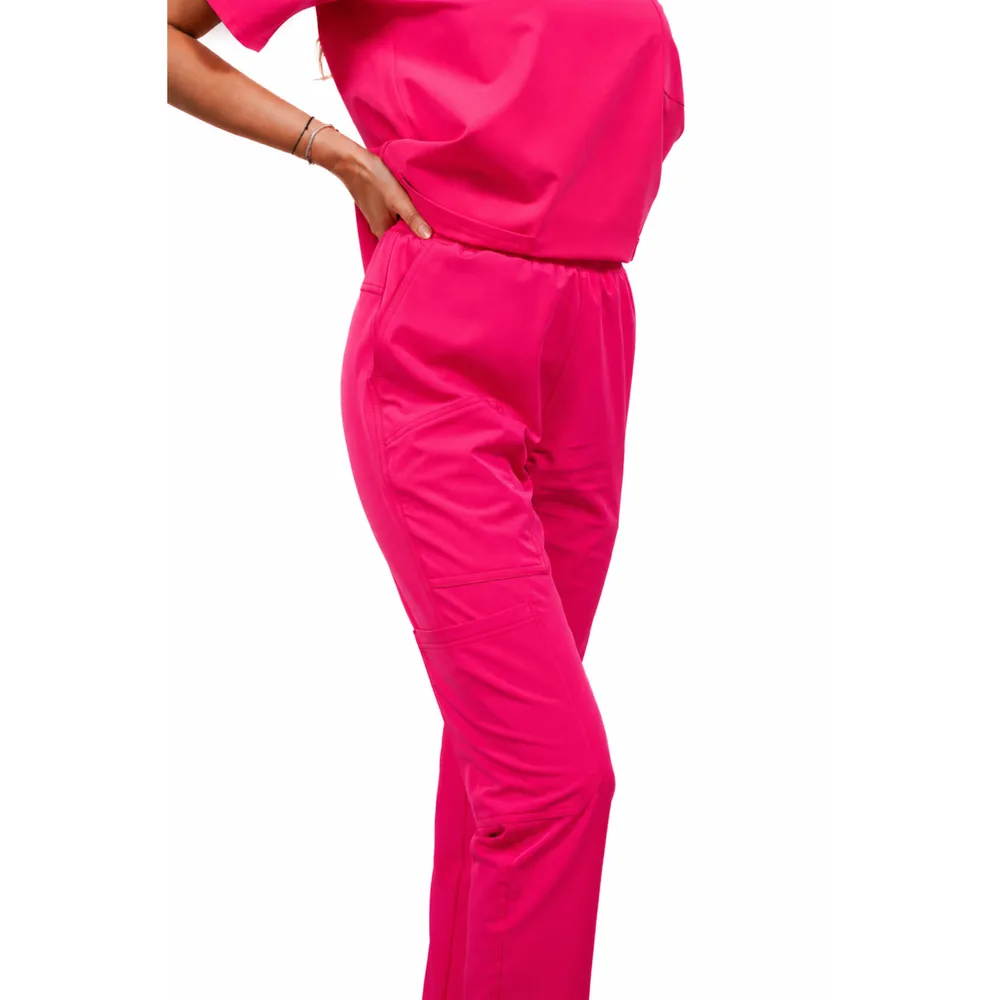
Almost any set of scrubs can handle the first hour of a shift. The difference between good scrubs and merely acceptable ones does not show in the mirror at the start of the day: you feel it after hour eight, in your shoulders, your waist and your knees. A seam that pulls every time you reach out, a waistband that digs in when you bend, a fabric that keeps sweat sitting on your skin: each one is a trifle at nine in the morning and a burden at nine at night.
Comfortable scrubs are not a matter of luck but the sum of a few technical decisions you can check before buying: the stretch of the fabric, the way the weave handles heat and sweat, a cut that puts room exactly where the body works, pockets that save you trips, and seams that do not give up under heavy wear. This guide takes them point by point.
You will find all of the criteria below in every model of medical scrubs we cut in our factory, across the 8 sizes in our range, from XXS to XXXL, because long shifts are precisely what we tested them on.
Stretch: why 4-way stretch beats a loose cut
On a long shift, the elasticity of the fabric matters more than the looseness of the cut: a 4-way stretch fabric follows the body through every movement, while a loose cut merely moves the problem somewhere else. The PI fabric we use for most of our models, 92% polyester and 8% elastane, stretches lengthwise and widthwise alike and recovers its shape every time.
Think about the actual movements of a shift: you lean over a bed, crouch at a bottom drawer, lift a patient, reach for the IV bag on the stand. Rigid scrubs bought a size up “for room” solve nothing: the extra fabric folds and bunches, snags on rails and bed edges, and still pulls at the knees and shoulders, because the weave itself does not give.
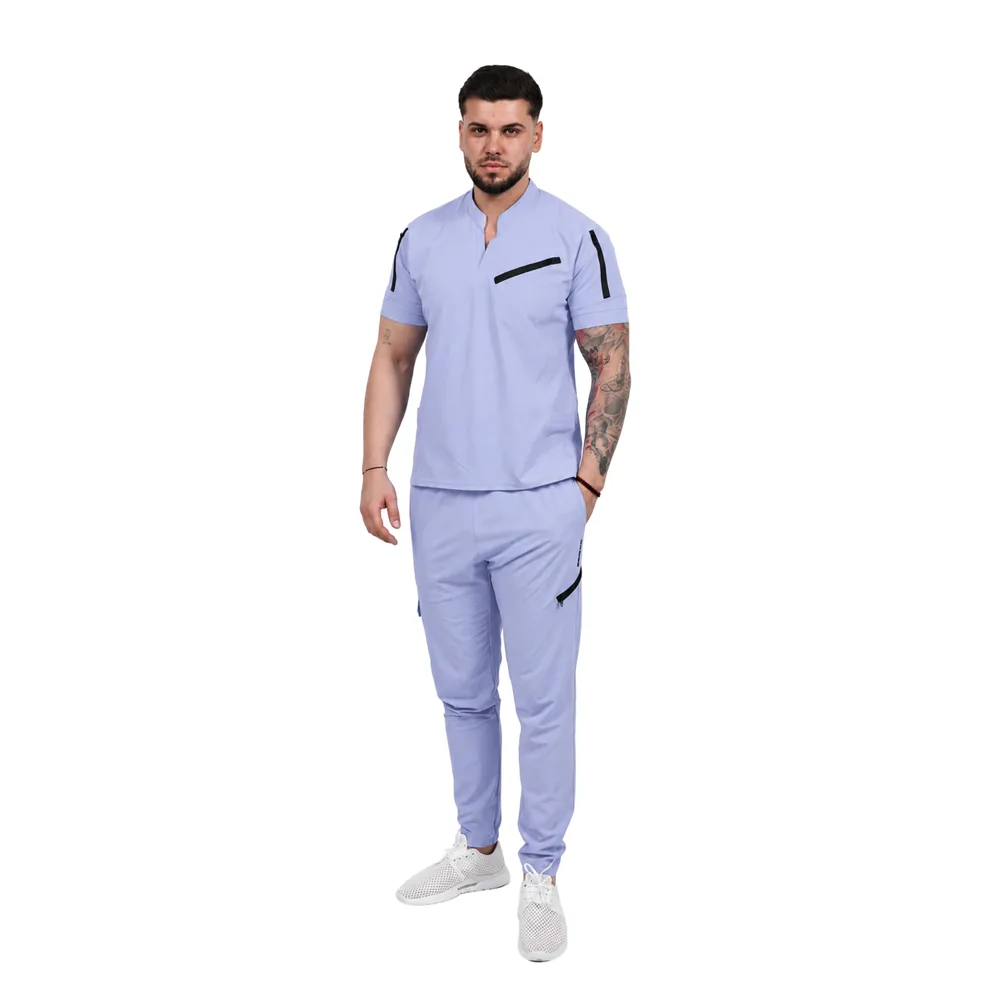
Stretch fabric works the other way around: it sits close to the body at rest and extends only when the movement calls for it. That is why 4-way stretch scrubs in the correct size feel better at the end of a shift than rigid ones a size larger.
Temperature regulation and breathability: from overheated wards to cold corridors
A fabric that breathes and dries fast is what separates a tiring shift from an exhausting one, because hospital temperature is never just one temperature. Scrubs worn through a 12-hour shift pass through several microclimates: overheated wards, warm treatment rooms, corridors and stairwells where the draught shows no mercy, a few minutes outside at a handover.
Temperature regulation means the weave helps your body keep its temperature in check in both directions: it does not smother you in a hot ward and does not leave you frozen in the corridor. Breathability lets air move through the fabric, so sweat does not stay trapped against your skin.
On top of sweat there is water from the outside: hands washed dozens of times a day, disinfectant, splashes at the sink. The PI weave is hydrophobic, it does not pull liquid into the fibre on first contact, so a quick splash brushes off with the back of your hand instead of becoming a damp patch that follows you for the rest of the shift.
Fast drying closes the loop: the PI fabric dries in about 30 minutes, so scrubs dampened by a sprint up the stairs or a hectic hour do not stay wet until the end of the day. A slow-drying fabric turns every burst of effort into an hour of cold, clammy clothing on your back.
The cut: where the room should be, and where it should not
Room to move belongs exactly where the body works, at the shoulders, the underarms and the knees, not spread evenly everywhere. Our cuts are tested on medical professionals, and those tests keep reaching the same conclusion: a well-cut uniform is trim where the body is static and generous where the body bends.
On a top, the critical points are the shoulder and the underarm: with room to move there, you can raise your arms without the top riding up or pulling across your back. On trousers, the knee and the rise matter most, while an elastic or drawstring waist forgives the natural difference between the start and the end of a long day. The elastic-waist styles in our women’s scrub trousers range are built on exactly this logic.
All of it only works in the right size: an excellent cut worn one size down pulls, and one size up hangs. How to measure yourself and read each model’s chart is covered step by step in our guide to choosing your scrubs size.
One simple test on first wear tells you everything: raise your arms fully, cross them in front of you, crouch down, then sit on a chair. If the top stays in place and the trousers do not pull at the knees in any of those positions, the cut and the size have both done their job.
Pockets: the small logistics of a shift
A well-placed pocket saves dozens of trips per shift, because it carries exactly the items you would otherwise walk back to the station for: the pen, the scissors, the phone, the tourniquet, a roll of tape, the access card, the notebook. Medical staff carry a small toolkit in their pockets, and scrubs with few or badly placed pockets shift all that logistics onto tables and windowsills.
Different styles organise the load differently. Cargo pockets, set on the thigh, carry bulky items without getting in the way of your stride or distorting the line of the trousers. A kangaroo pocket on the top keeps your most-used items within reach: you pull out the pen one-handed, without looking. Multi-pocket jogger cuts combine both ideas, with separate compartments that stop items from mixing and rattling at every step.
One detail worth checking before you buy: the pocket has to hold its contents when you bend over. Depth and position matter more than quantity; six pockets that spill are less useful than three that hold. Test it with your own phone too: today’s screens call for a deeper pocket than those of a few years ago.
The psychological weight: scrubs you look good in
Comfort also has a component no measuring tape can capture: how you feel when you catch sight of yourself in uniform. A flattering cut is not a vanity, it is part of the equipment: you pass mirrors, glass doors and patients all day long, and scrubs you like the look of are worn with a different energy than ones you merely tolerate.
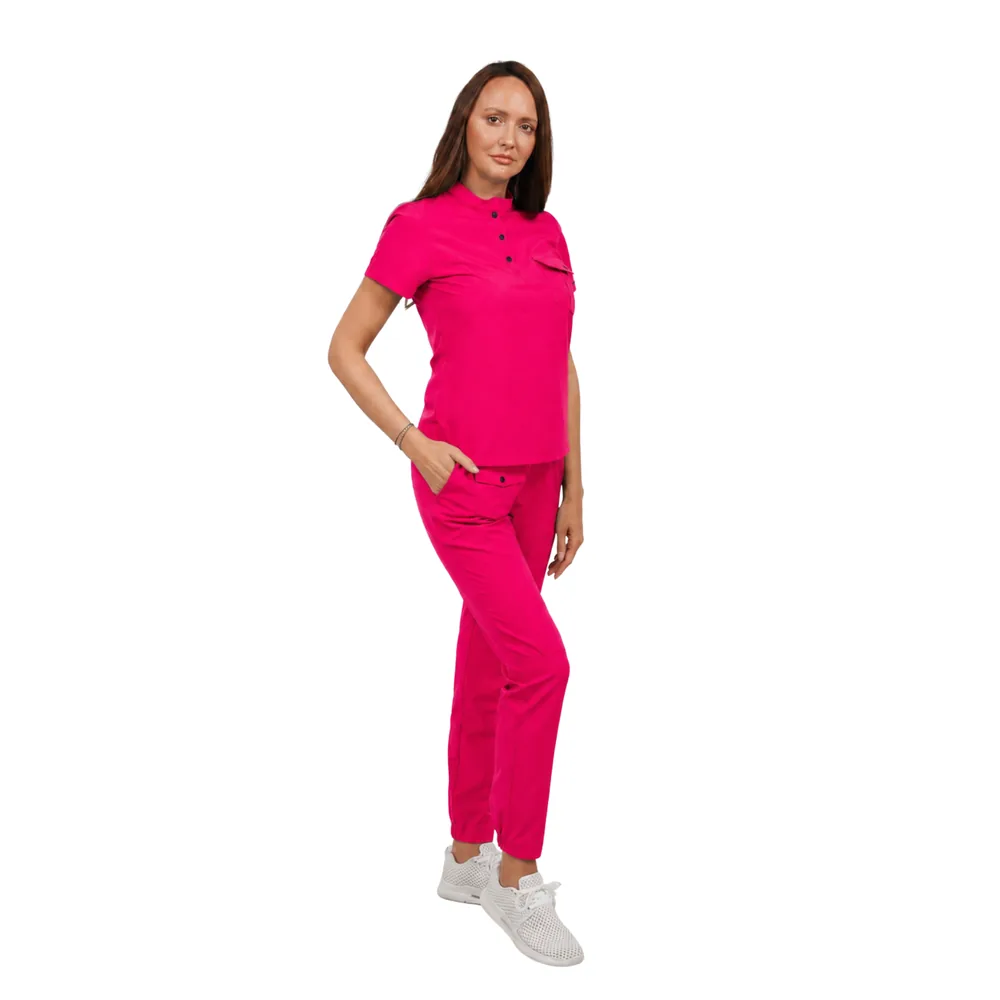
Colour belongs here too. The right shade depends on your skin tone, your ward’s rules and the message you want your uniform to send, and the choice is anything but random: we devoted a separate guide to medical scrub colours. There is plenty to choose from: the PI fabric comes in 18 colours and the Gofra weave in 6 more, so the same cut can be worn quietly or boldly, to suit your taste and your workplace rules.
One more practical detail feeds directly into this psychological weight: the PI fabric needs no ironing. Scrubs taken straight off the hanger look neat with zero extra effort, which, on a schedule of long shifts and short breaks, is one entire chore struck off the list.
The durability details: what you cannot see in the first month
Scrubs for long shifts should be judged by their hundredth wash, not their first wear, because an intense working rhythm means an intense washing rhythm too. The PI fabric withstands over 100 industrial washes without losing its shape, and the antimicrobial treatment in the weave works quietly between washes.
The places where scrubs fail first are always the same: the underarm, the rise, the corners of the pockets, exactly the spots strained by the repeated movements of a shift. That is why our models have triple stitching at the stress points: where a single seam comes undone after a few months of heavy wear, a triple seam holds.
Durability also depends on care: the wrong cycle or a chlorine bleach shortens the life of any weave. The complete rules, from water temperature to drying, are in our guide to washing medical scrubs.
Frequently asked questions
Jogger or classic cut for long shifts?
Both work, and the choice comes down to your working style. The jogger cut, with an elastic ankle cuff and a drawstring waist, sits close to the body, does not snag and has a sporty feel; the classic straight cut looks more formal and leaves more air around the leg. Both are cut from the same 4-way stretch fabric, so you lose nothing in freedom of movement either way.
What should I wear under my scrub top in winter?
A thin, close-fitting base layer in a breathable synthetic fabric: a t-shirt or a fitted long-sleeve top. Avoid thick cotton layers, which trap sweat and cancel out the very breathability you chose your scrubs for. For cold corridors and trips across the yard, a warm outer layer such as our hooded fleece gown goes on and comes off in seconds, without overheating your base layer.
How often should I change my scrubs during a long shift?
Follow your ward’s and your hospital’s rules first, because they take precedence. As a principle, visibly soiled or contaminated scrubs are changed immediately, not at the end of the day, so a spare set within reach is cheap insurance. How many sets you need in total, depending on your shift and laundry rhythm, is worked out in our guide on how many sets of scrubs you need.
Is there such a thing as “the most comfortable scrubs”?
Not as a single model that suits everyone: the most comfortable scrubs are the ones matched to your body and your shift. The formula, however, is the same for all: a stretch fabric that breathes and dries fast, a cut with room at the shoulders and knees, pockets arranged around your working habits, and a size chosen from measurements, not habit. Tick those boxes and hour twelve will feel a lot more like hour one.