
Guide
How to choose your medical scrubs size: a step-by-step guide

The wrong size is the most common reason a set of medical scrubs gets sent back. It is also behind most of the discomfort you feel on shift: a top that pulls at the shoulders when you raise your arms, trousers that dig into your waist after a few hours, sleeves that ride over your gloves. In most cases the garment itself was fine; the number on the label was simply picked in a hurry.
The good news: you can get the size right the first time. All you need is a tailor’s measuring tape, five minutes, and a little care in how you read the size chart. This guide walks you through the whole process: how to take your measurements, how to compare them with the chart, what to do when you fall between two sizes, and how to spot scrubs worn in the wrong size.
The rules below apply to all the medical scrubs we make in our factory, tops and trousers alike, across the 8 sizes in our range, from XXS to XXXL.
Why your regular clothing size does not carry over to scrubs
The size you wear in everyday clothes does not transfer automatically to scrubs, because medical uniforms have a professional cut designed for movement, not for a static silhouette. A t-shirt has to look good while you stand still. A scrub top has to let you lift a patient, bend down for a dropped tray, and reach for a vial on the top shelf, dozens of times per shift, without riding up or pulling at the underarm.
Add to that the chaos of regular fashion sizing: one brand’s M is another brand’s L, and some labels flatter on purpose. Our cuts are tested on medical professionals, and the pattern of every model is published in its own size chart, so there is nothing to guess.
One more thing changes the rules: the fabric. The PI fabric we use for most models has 4-way stretch, so it follows the body in motion and is far more forgiving than rigid cotton. Scrubs made from a 4-way stretch fabric do not need the same amount of ease as a fixed weave. If you are curious why composition matters so much, we cover it separately in our guide to medical scrubs fabric.
How to measure yourself correctly
To choose your size you need four measurements: bust, waist, hips and height, taken with a tailor’s tape directly on the body. A few rules apply to all of them: measure over underwear, not over thick clothing; keep the tape horizontal, parallel to the floor; let it touch the body without squeezing; breathe normally and do not pull your stomach in. If someone can help you, even better, since the tape tends to slip on your back. Write the numbers down, you will need them in a moment.
Bust
Pass the tape under your arms and measure over the fullest part of your chest. Check in a mirror that the tape sits at the same level on your back, not pulled up towards the shoulder blades. Do not tighten it: the tape should touch the body, not compress it. Bust is the key measurement for tops.
Waist
Measure at the narrowest point of your torso, usually just above the navel. Stand relaxed: a waist measured with your stomach pulled in gives you a size that pinches in the second half of the shift. If you wear your trousers below the natural waist, also measure where the waistband actually sits.
Hips
Bring your feet together and measure the circumference at the widest point of your hips and seat. For trousers, the hip is usually the deciding measurement: a waistband can be adjusted with a drawstring or elastic, but a tight seat is non-negotiable.
Height
Stand against a wall, without shoes, and measure from the floor to the top of your head. Height does not change your circumferences, but it matters for the length of trousers and tops: the same size falls very differently on a short frame than on a tall one, and our size recommendation tool uses it in its calculation.
How to read the Antonia Conf size chart
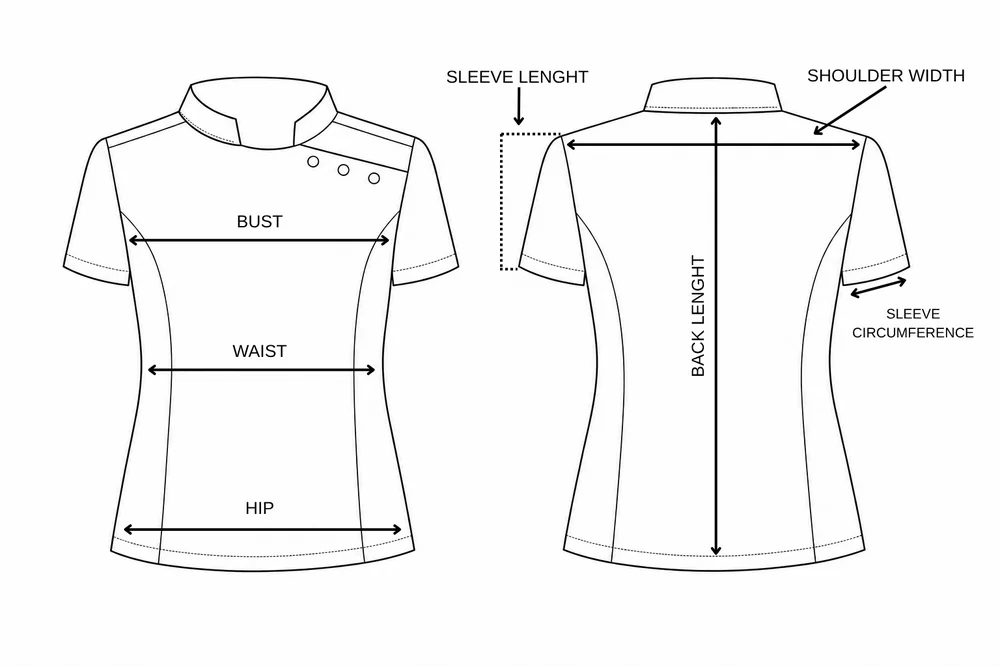
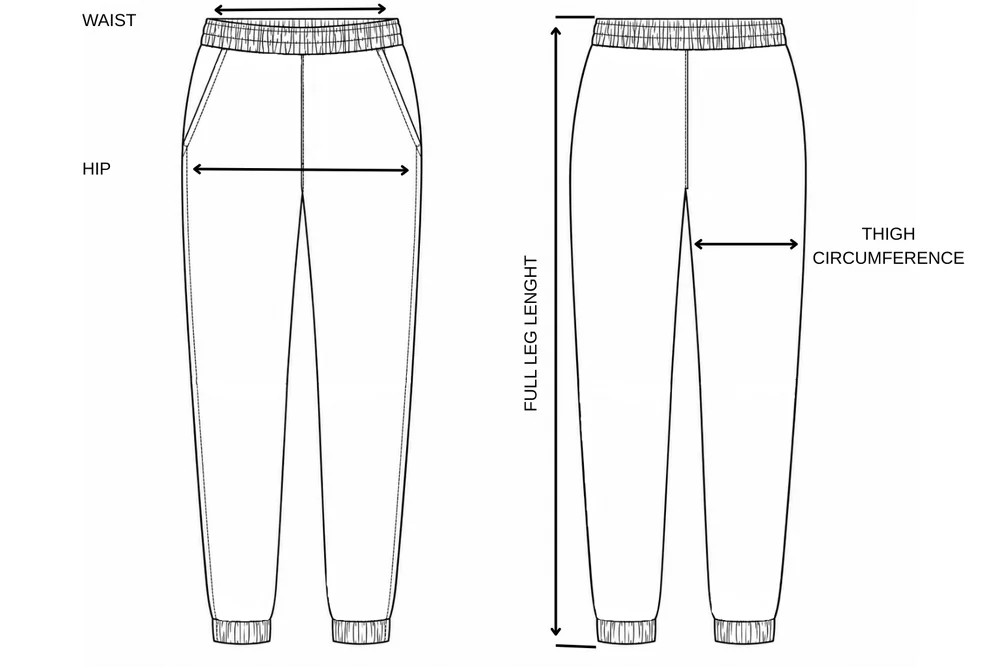
Our size charts show the dimensions of the garment measured flat, not body measurements, and this is the essential difference to keep in mind. Many guides online list body ranges: “if your bust is this, wear an M”. We chose to publish exactly what the tailor measures on the garment laid flat on the table, between 8 and 13 measurements per model, in centimetres and inches: widths, lengths, sleeves, rise, waistband.
How do you compare the numbers? A width measured flat, for example the top’s width at the bust, becomes the garment’s circumference when doubled: front plus back. You then compare the garment’s circumference with your own body circumference from the previous step. The golden rule: the garment must be larger than the body. Well-fitting scrubs have ease over your body measurement, meaning room to move and breathe; exactly how much depends on the model’s cut and the fabric’s stretch, which is why no universal allowance exists.
Here is a tailor’s trick that never fails: take a garment you wear often and that fits you well, lay it flat on a table and measure it the same way. Compare its numbers with the product’s chart and pick the closest size. Comparing garment to garment, rather than body to garment, removes all the ambiguity.
One more detail: every model has its own chart, because every cut has its own pattern. Do not assume a size from one model transfers identically to another; checking takes a minute and saves a return parcel.
The size recommendation tool on our product pages
On every product page you will find a tool that recommends your size based on your height, weight and circumferences. Enter the measurements you have just written down, and the tool compares them with that specific product’s size chart, not a generic grid, and returns the size that fits that particular pattern.
The recommendation is indicative: it is an excellent starting point, especially on a first order, but it does not replace your own judgement about how you like to wear your scrubs. If you know you prefer a relaxed fit, factor that in: treat the result as a reference and adjust. You can see the tool in action, for example, on the page of the Elite Pocket women’s scrub trousers, right next to the size chart.
Between two sizes? How to decide
If your measurements fall between two sizes, the decision comes down to three things: the fabric, the cut, and how you like to wear your scrubs. With our 4-way stretch PI fabric, the smaller size usually remains comfortable, because the weave stretches with the body and recovers its shape. If you prefer a relaxed silhouette with visible room to spare, go for the larger size without hesitation.
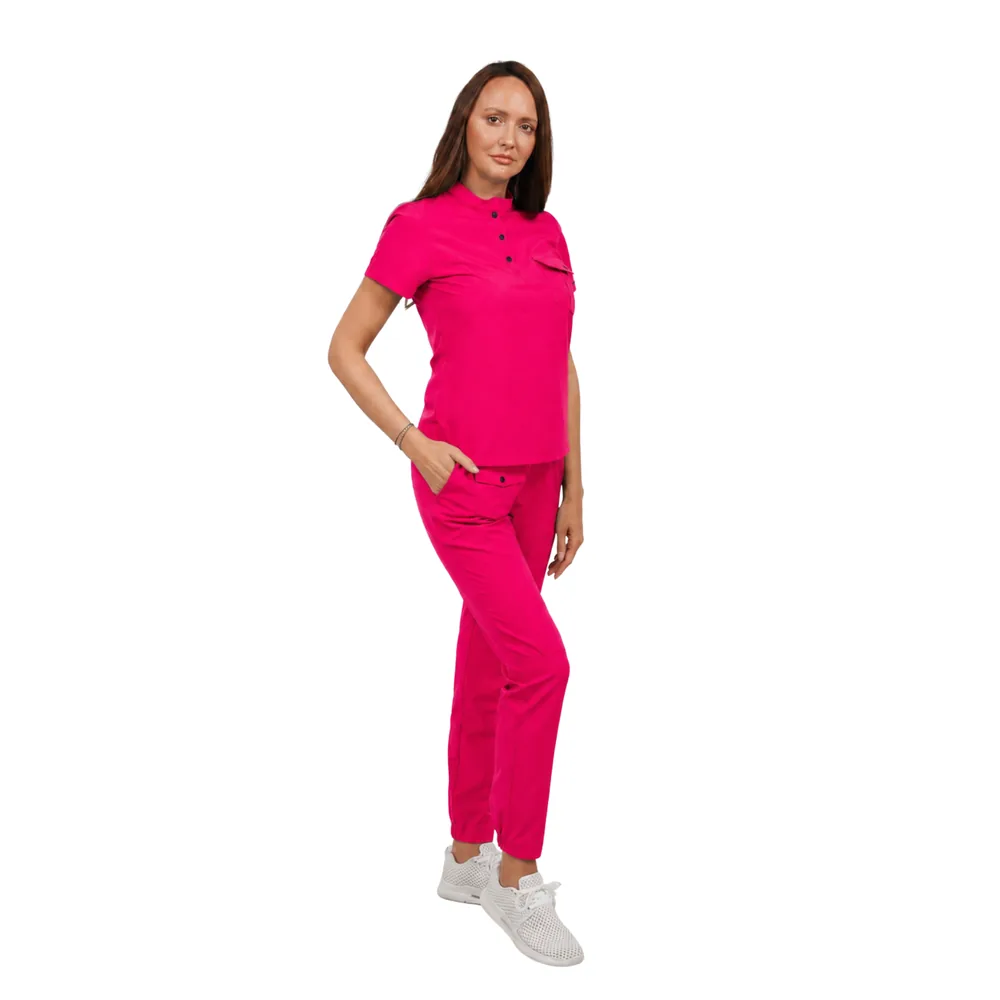
Tops and trousers are judged separately. For tops, bust and shoulders come first: a shoulder seam that sits wrong cannot be fixed, so make no compromises there. For trousers, waist and hips decide, and between the two, the hip has the final say. It is perfectly normal for your top to be one size and your trousers another; that is exactly why the pieces are sold separately, both in our women’s collection and in the men’s collection.
Signs you are wearing the wrong size
Ill-fitting scrubs give themselves away through concrete signs that show up during the shift, not just in the mirror. If two or more of the following sound familiar, it is worth re-checking your measurements:
- The shoulder seam does not sit on your shoulder: dropped onto the arm means the top is too big; pulled towards the neck and tugging at the underarm, too small.
- The top comes untucked or bares your back every time you raise your arms.
- The fabric forms tension creases across the bust or between the shoulder blades, a sign it is pulling.
- The waistband leaves visible marks on your skin at the end of the shift.
- The rise sags and you find yourself hitching up your trousers several times a day.
- Sleeves reach past the base of your palm, or pockets gape open with nothing in them.
None of these fix themselves “with wear”. Scrubs in the right size sit the same in hour one and hour twelve of a shift.
If it still does not fit: exchanging is easy
You have 14 days from receiving your order to return or exchange scrubs that do not fit, under Romanian consumer law (GEO 34/2014). Try everything on as soon as it arrives, with the tags still attached: make a few wide movements, raise your arms, sit down. If the size is not right, the step-by-step procedure is described on our returns page, and exchanging for another size is the shortest route.
A practical tip for your first order: do not buy five sets in the same size straight away. Order one top and one pair of trousers first, wear them for a shift, then build up your wardrobe in the confirmed size. How many pieces you need in total, depending on your shift and laundry rhythm, is covered in our guide on how many sets of scrubs you need.
Frequently asked questions
Do sizes differ between models?
They can differ slightly, because each cut has its own pattern: a wrap-neck top sits differently from a classic one, and trousers with patch pockets differently from a plain pair. That is why every product page carries its own size chart and its own recommendation tool. Check the chart for every new model, even if you have ordered from us before.
What size should I choose if I am pregnant?
Choose a roomier size than usual, based on your current circumferences, not the ones from before your pregnancy. The 4-way stretch fabric helps a great deal, because it adapts as your silhouette changes. Use the recommendation tool with up-to-date measurements and re-measure from time to time; it is natural for your best size to shift along the way.
Do the scrubs shrink in the wash?
No. The PI fabric is 92% polyester and 8% elastane, a synthetic weave that does not shrink the way cotton does, and it withstands over 100 industrial washes. Wash your scrubs at 30-40°C on a synthetics cycle and dry them naturally on a hanger; they dry in about 30 minutes and need no ironing. The size that fits you today will still fit after a year of wear.
Can I order the top and the trousers in different sizes?
Yes, and we actively encourage it if that is what your measurements say. Tops and trousers are sold as separate pieces precisely because few bodies are a perfect match for the same size on top and bottom. Choose the top by bust and shoulders, the trousers by waist and hips, and each piece will sit exactly as it should.