
Guide
The best fabric for medical scrubs: polyester-elastane vs cotton
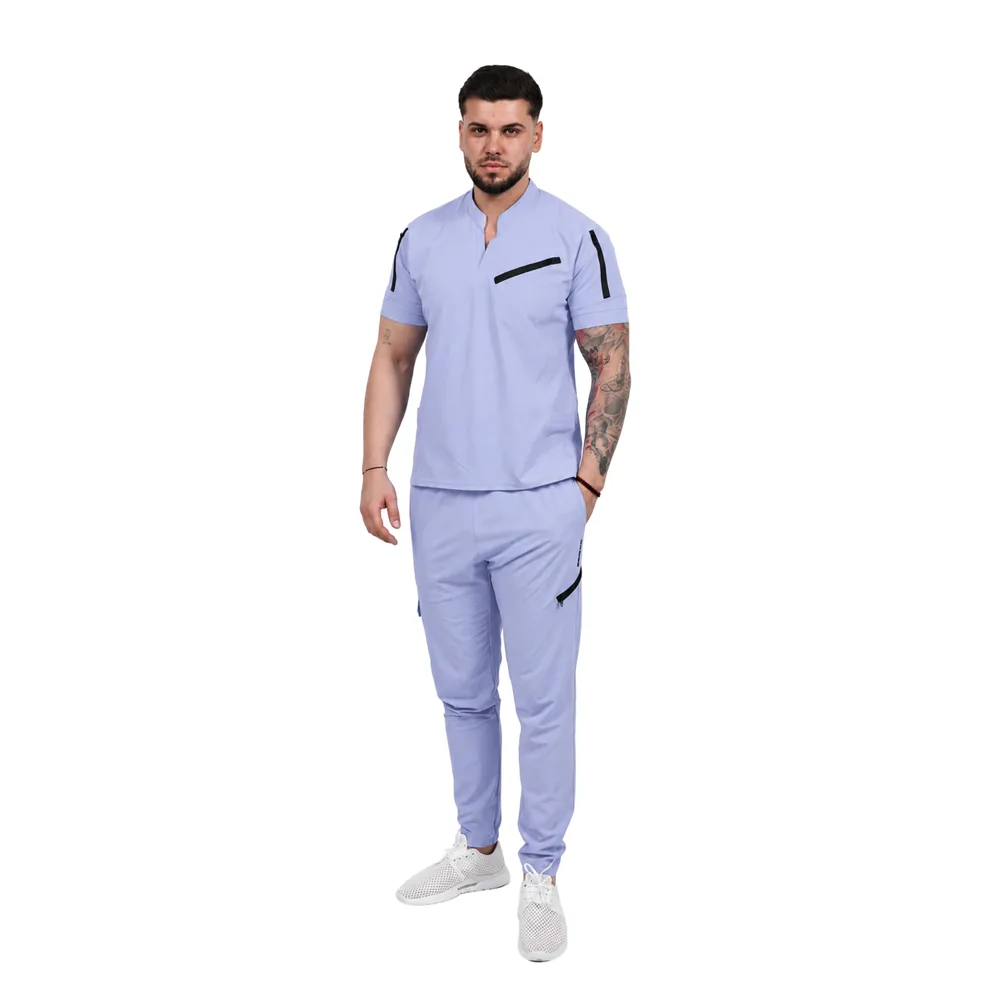
If you are wondering what modern medical scrubs are made of, the short answer is: a blend of polyester and elastane. This combination dominates today’s professional wardrobe in hospitals, clinics and practices, and not by accident: it simply withstands a rhythm of wear and washing that few fabrics can take. Pure cotton, the traditional fabric of the white coat, has not disappeared, but its role has shifted towards garments worn rarely and washed gently, not towards the uniform that goes into the machine after every shift.
The fabric matters at least as much as the cut. It decides whether your top moves with you or pulls at every bend, whether it looks at the end of the shift the way it did at the start, whether it dries overnight, and whether after a year of washing it still holds its shape and colour. An excellent cut in the wrong fabric is still the wrong uniform.
This guide shows you exactly what to look for: how the polyester-elastane blend compares with cotton, what 4-way stretch actually means, what the treatments applied to the fabric do, and how to spot a good fabric before you press “add to cart”. The rules apply to any medical scrubs, not just the ones we make.
Polyester-elastane or cotton: an honest comparison
The polyester-elastane blend clearly wins on durability, drying, creasing and stretch, while cotton keeps the advantage of its natural feel on the skin; the difference shows most clearly when you compare them point by point. Neither fabric is “bad”, but medical scrubs are an extreme use case: worn for hours on end, in constant motion, washed several times a week, often at high temperatures. Judge the fabrics through that lens, not by how they feel at first touch.
How they behave over repeated washing
Frequent washing is the test cotton fails first. The natural fibre wears down with every cycle: it shrinks, gradually loses its colour, and over time the weave thins out and loses its shape. Polyester is a stable synthetic fibre that does not shrink and does not fade nearly as fast, and the elastane blend springs back into shape after every wash. The PI fabric we cut most of our styles from withstands over 100 industrial washes, meaning the tough regime of professional laundries, not just the delicate cycle at home.
Creasing
Polyester holds its shape on its own: the uniform comes off the hanger ready to wear, no iron required. For anyone leaving for an early shift, “no ironing needed” is not a luxury, it is an extra half hour of sleep per week. Cotton, by contrast, creases easily: a cotton coat or top demands ironing after every wash, or it looks worn out before you even put it on.
Drying
Synthetic fibre does not absorb water into its core, so it dries fast: PI fabric is dry in about 30 minutes on a hanger. Cotton soaks up a lot of water and gives it up slowly; a thick cotton uniform washed in the evening can still be damp in the morning. When you work back-to-back shifts with only two or three sets in the wardrobe, drying speed becomes a matter of logistics, not comfort.
Stretch
Classic woven cotton barely stretches at all: every bit of freedom of movement has to come from a looser cut, which means extra fabric. Elastane changes the rule: even a small percentage of elastic fibre makes the weave follow the body and recover its shape without sagging. That is why stretchy medical scrubs can have a closer, more flattering cut without sacrificing any range of motion.
What 4-way stretch means and why it matters on shift
4-way stretch means the fabric stretches both across and lengthwise, and returns to its original shape after every stretch. Ordinary stretch fabrics give only in one direction, usually across; that is enough for a street t-shirt, but not for a full shift of movement in every plane.
Think about an ordinary day: you bend down for a dropped tray, reach for a vial on the top shelf, lift a patient, crouch at a socket near the floor, push a bed. Each of those movements pulls the fabric in a different direction. A 4-way stretch fabric follows all of them, then settles back into place: the top does not come untucked when you raise your arms, and the trousers do not pull at the knees when you crouch.
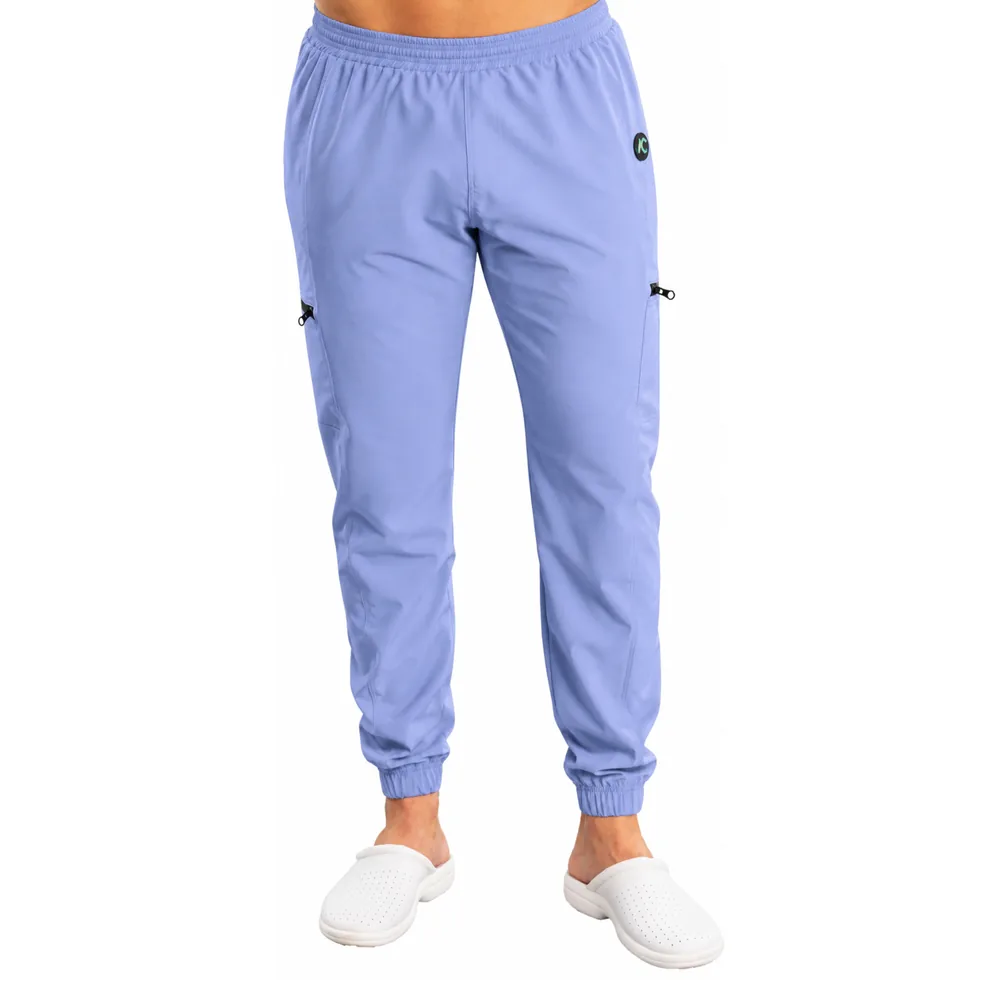
Stretch has one more invisible effect: it shifts the tension from the fabric into the seams. That is why, on our styles, the stress points are closed with triple stitching; the fabric can stretch thousands of times, and the seam has to hold every single one.
The treatments that make the difference
A good fabric is not just well woven but also treated: four properties added to the weave change how the uniform behaves day to day. They do not show up in photos and rarely appear on the label with any explanation, so they are worth translating into plain language.
Antimicrobial treatment
The antimicrobial treatment keeps bacteria from developing in the fabric between washes, which in practice means a uniform that stays fresh longer, without the odour that settles into untreated fabrics towards the end of a shift. One thing must be said plainly: this is a hygiene property of the fabric, not protective equipment. It does not replace hygiene protocols, proper washing, or dedicated protective wear where that is required.
Hydrophobic finish
A hydrophobic fabric repels liquids instead of drawing them into the fibre: a splash of water, coffee or disinfectant beads up and wipes off, rather than spreading instantly into a stain. This is not a waterproof barrier but a grace period: you have time to dab before the liquid soaks in, and whatever does reach the fabric comes out more easily in the wash.
Thermoregulation
Thermoregulation helps your body hold a comfortable temperature: the fabric lets air circulate and moves moisture away from the skin to the surface, where it evaporates. You feel the effect in sudden changes of environment, stepping from a cool corridor into a heated ward, or in the busy hours when you never get to sit down. Breathability works in the same direction: the skin is not sealed inside an airtight layer, the way it is with dense older-generation synthetics.
Quick drying
Drying in about 30 minutes completely changes the logistics of your wardrobe: scrubs washed in the evening are dry before bedtime, not draped over a radiator in the morning. The same mechanism works during the shift: sweat from the intense hours evaporates quickly, so the fabric never sits damp and cold against your skin. Together with thermoregulation, this is the difference between scrubs you forget you are wearing and scrubs you cannot wait to take off.
How to recognise a good fabric in an online store
You can recognise a good fabric before the first try-on by how the store talks about it: whoever has a quality weave describes it precisely, and whoever does not hides behind vague wording. Four checks take two minutes:
- Composition shown in percentages. “92% polyester, 8% elastane” is information; “premium breathable fabric” with no percentages is not. If the product page does not state the composition, ask before you order.
- Stretch declared explicitly. Look for “4-way stretch” spelled out. The mere presence of elastane does not guarantee stretch in both directions; if it just says “stretchy”, it may only give one way.
- The visual weight of the fabric. Look at the photos on a model: a good fabric drapes with a certain weight, holds the line of the shoulder and does not let you guess what is underneath. Thin, shiny weaves give themselves away even in pictures.
- A serious size chart. Whoever measures the garment at 8-13 points and publishes the numbers knows their pattern; whoever lists only S-M-L with no dimensions, less so. How to use the chart to get the size right first time is covered step by step in our guide to choosing your medical scrubs size.
Our fabrics: PI and Gofra
In our factory we cut our scrubs from two fabrics: PI, the main one, and Gofra, the textured alternative. We chose them by the same criteria described above, and you can read about the factory and our journey from the first pattern on our About us page.

PI, trade name Pixie, is a blend of 92% polyester and 8% elastane, the Spandex fibre that provides the 4-way stretch. It carries every treatment described earlier: antimicrobial, hydrophobic, thermoregulating, quick-drying in about 30 minutes, and it needs no ironing. It withstands over 100 industrial washes, which also makes it suitable for teams whose uniforms go through professional laundries. We produce it in 18 colours.
Gofra is the choice for anyone who wants a surface with personality: a fabric with a raised texture that catches the light differently from PI’s smooth face and gives the uniform a feel closer to everyday clothing. It comes in 6 colours, for example on the Gofra women’s scrub top. Between them, the two fabrics cover 24 colours, enough for every team to find its shade.
Care matters as much as the fabric
The best fabric loses its qualities if it is washed wrong, so the care rules are part of the choice. The good news is that synthetics ask for little: wash at 30-40°C on the synthetics or sports cycle, dry naturally on a hanger, skip chlorine bleach, and leave the iron in the cupboard or, if you must, use it on minimum, inside out, with no direct steam.
High temperatures and chlorine are elastane’s enemies: the elastic fibre tires under aggressive heat, and the uniform loses exactly the property you chose it for. All the rules, plus solutions for stubborn stains and the mistakes that shorten a uniform’s life, are gathered in our guide to washing medical scrubs.
Frequently asked questions
Is polyester hot in summer?
In the dense polyester of the old generation, yes; in modern treated weaves, no. PI fabric is breathable and thermoregulating: it lets air circulate and moves sweat away from the skin to the surface, where it evaporates instead of staying in the fibre. No uniform will cool you down in an overheated ward, but one that dries moisture quickly feels far better than a wet weave stuck to your skin.
Why not 100% cotton?
For a uniform worn daily and washed several times a week, pure cotton loses on too many counts: it creases, dries slowly, has no stretch and wears out visibly under frequent washing. It remains a pleasant fibre on the skin, suited to garments worn occasionally or to anyone who prefers the natural feel and accepts the ironing. For the rhythm of a shift, the polyester-elastane blend is simply the better fit.
What is elastane?
Elastane, also known as Spandex, is a synthetic fibre that can stretch to several times its length and return to its original shape. It is never used on its own: it is blended in small percentages with other fibres, lending them its elasticity. The 8% in our PI fabric is enough for the weave to move with the body without losing its shape.
Does the fabric survive industrial laundering?
Yes, PI fabric withstands over 100 industrial washes, meaning professional cycles harsher than a home machine’s programme. For clinics and teams that work with external laundries, this is the criterion that separates a uniform from a disposable. At home, keep to 30-40°C and avoid chlorine, and the scrubs will still look good long after you have grown used to them.